“Multimedia in education begins
with the assumption that students will find learning more interesting if more
than one mode of learning is used for teaching.”-Maloy, et al., Transforming Learning with New Technologies
(2017)
Maloy, et al. (2017) define
multimedia in the following manner: “Multimedia means ‘the presentation of
material using both words and pictures’” (p. 214), in Chapter Nine of their text Transforming
Learning with New Technologies. However, as they make it abundantly clear
to their readers after the presentation of that definition, the multimedia of
today is inherently more complex than the multimedia of yesterday. Today, “multimedia
is part of media synergy where
video, digital, and print materials, combined with in-person instruction, build
technology-based learning environments for students” (p. 214). This incorporation
of multimedia in media synergy is quite important since the world of today—especially
the world of our students—is becoming more and more digital by the second.
Maloy, et al. (2017) go on to
explain that multimedia is incorporated into a concept known as “multimodal
learning”: “Multimodal learning means
teachers combine spoken words with visuals, written text with audio, or
simulations with models” (p. 214). As indicated by the excerpted quote at the start
of this post, students become more engaged in what they’re learning if the what
they’re learning is done a multidimensional, or “multimodal” level.
Now, Walker, et al. (2016) in strategies three and four of Chapter Three
of their text Teaching the Last Backpack
Generation identify three forms of multimedia worth discussing: video, quick
response (QR) codes, and augmented reality (AR). We will start with video.
Maloy, et al. (2017) state the following in regard to video: “Videos, widely
used in classroom teaching, offer ways to present information multimodally and
redirect the method of instruction from teacher to screen for portions of class
time” (p. 224). Videos, thereby, are quite important in engaging our students
since they allow for the interest of the student to be taken into
consideration, they offer a resource abundance, and, finally, they allow for
students to be uniquely taught (p. 224). Walker, et al. (2016) further highlight
that “videos can be watched on mobile devices, computers, or televisions” (p.
55). Therefore, if a teacher only has access to, simply, a Smartboard and a
computer, they can easily implement this feature into his/her classroom, even
if not every student has their own devices with them.
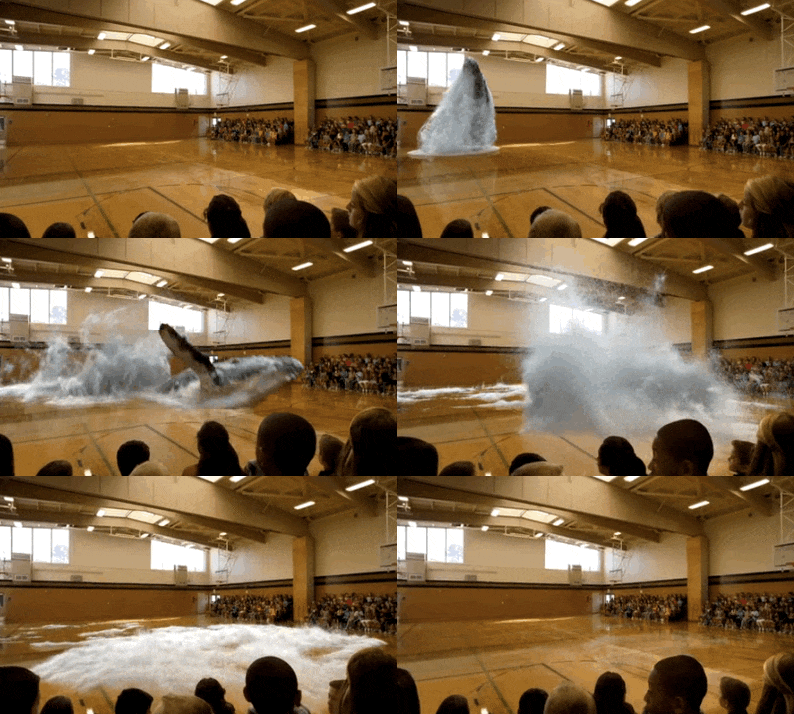
Next, are the concepts of AR and QR
codes. Walker, et al. (2016) state the following of these features: “Quick response (QR) codes and augmented reality
(AR) blend computer-generated images (virtual) and layer them onto the real
world (physical) to enhance our perceptions and experiences” (p. 68). The
authors then point to AR as, perhaps, being one of the best ways to have a
multimodal approach to learning (p. 68) to them.
I’d like to end this post with the
following discussing on minimal and multimedia classroom technologies. Maloy,
et al. state the following: “Understanding the potential of multimedia technologies
begins by examining their impact on teaching and learning in a classroom” (p.
216). The authors explain that older—perhaps outdated—classrooms often have
minimal tech, which then leads to having minimal multimedia within a teacher’s
classroom strategies. Students, the authors continue to point out, learn
through hands-on experiences and materials (p. 217). Finally, they state: “By contrast,
in a technology-integrated classroom, the use of text, voice, video, images,
and sound allows teachers to contribute to the wide range of minimal classroom
experiences by increasing multimodal options for learning…” (p. 217). Therefore,
multimodal learning bridges the topics that we have been talking about over the
past few weeks: creativity and autonomy.
I agree that QR and AR codes are great multimodal approach to learning. Virtual Reality and Augmented Reality allow students to see an image physically which enhances their understanding and experiences. Sometimes, you just need to see something physically to understand and AR makes it look really real as if it was in front of you.
ReplyDelete